
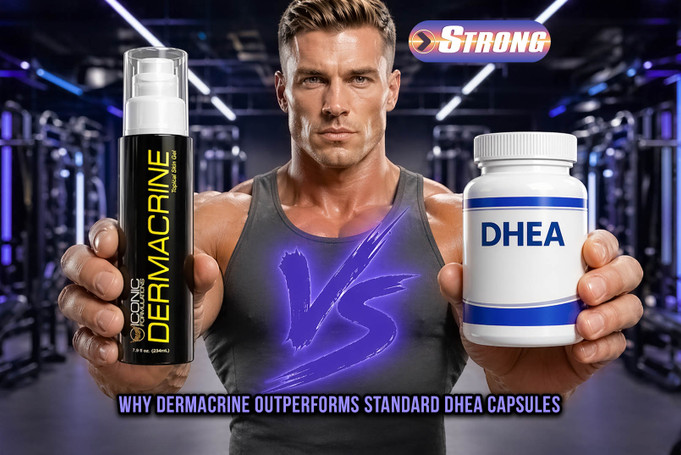
Why Dermacrine Outperforms Standard DHEA Capsules
Posted by Leonard Shemtob on Apr 24, 2026
You're taking DHEA every day. You read the label, you took the right dose, and you've been consistent. But something feels off — the results just aren't matching the effort. Here's the truth most supplement brands won't tell you: how you deliver DHEA matters just as much as how much you take.
Oral DHEA capsules have a serious problem, and it starts the moment you swallow them.
That's where Dermacrine by Iconic Formulations enters the picture.
When DHEA bypasses your digestive system entirely and gets delivered straight through the skin, your body responds differently.
Hormone levels stabilize, conversion is more efficient, and the compound actually reaches your bloodstream in meaningful amounts, which may provide steadier testosterone support, better hormone balance, and a more favorable environment for natural testosterone as the body reacts to a more efficient delivery method.
If you've been frustrated by mediocre results from your DHEA supplements, this guide breaks down exactly why that's been happening — and what a smarter delivery method actually looks like in practice.
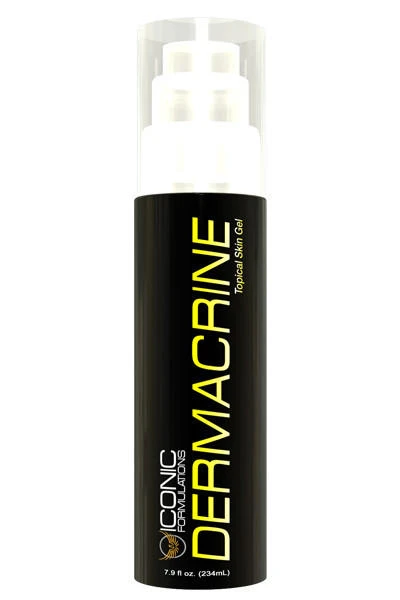
What Is Dermacrine?
Dermacrine is a hormone support gel containing DHEA made by Iconic Formulations. While it is not the same thing as topical testosterone or testosterone replacement therapy (TRT), it is designed for users looking for a non-prescription hormone-support option beyond basic test boosters.
At its core, Dermacrine is built around two powerful hormone precursors: DHEA (dehydroepiandrosterone) and pregnenolone.
[Related Article] Want the full breakdown of Dermacrine? Check out our Full Dermacrine Review article to learn more!
The Core Active Ingredients
Dehydroepiandrosterone (DHEA) is a hormone produced naturally by the adrenal glands and is involved in the broader network of hormones in the body that influence natural hormone production. Because DHEA levels naturally decline with age, this can become more relevant for men concerned about changing energy, recovery, or health status, especially when those issues overlap with symptoms commonly associated with low testosterone levels.
DHEA sits at the top of the hormonal food chain as a precursor to both androgens and estrogens. Your body uses it to convert into testosterone and estrogen as well as other sex hormones depending on what it needs (which is why DHEA is often described as a hormone precursor or prohormone with downstream androgenic relevance).
DHEA levels peak in your mid-20s and decline steadily with age, which is why supplementation becomes increasingly relevant as men get older, and why DHEA has also been studied in aging populations including elderly women and men.
Pregnenolone is another naturally occurring hormone produced from cholesterol. It's often called the "master hormone" because it acts as a foundational precursor that feeds into multiple hormone pathways, including DHEA itself.
Together, these two compounds create a layered hormonal base that supports more balanced and robust natural hormone production, which may help boost the environment that supports muscle mass and strength by optimizing natural testosterone output.
What Makes It a Transdermal Gel?
Unlike a DHEA supplement you swallow, Dermacrine is applied to the skin. The formulation is a topical gel that uses a specialized carrier system to push active compounds through the skin barrier and into circulation. This is the key differentiator — it's not just about what's in the formula, it's about how those compounds get into your body.
Standard DHEA supplements were designed around convenience. Dermacrine was designed around performance. The goal was to close the gap between the dosage on the label and the dose of DHEA that actually reaches your bloodstream, which is one reason transdermal delivery can sometimes do more with lower doses.
Why Standard Oral DHEA Capsules Fall Short
Let's talk about what happens inside your body when you take an oral DHEA supplement:
First-Pass Metabolism: The Big Problem
When you swallow a DHEA capsule, it travels to your stomach, gets broken down in your gut, and then absorbed into the portal blood system. From there, it heads straight to the liver — and that's where the problem starts.
The liver treats DHEA like a guest who showed up without an invitation. It metabolizes a significant portion of the compound before it ever makes it into general circulation. This is called first-pass metabolism, and it's the primary reason oral DHEA bioavailability is so poor.
Here's what that looks like step by step:
- You swallow a DHEA capsule
- Stomach acid and gut enzymes begin breaking it down
- The compound is absorbed into the portal vein
- The liver processes (and partially deactivates) it
- What remains enters systemic circulation — often a fraction of the original dose
Studies have consistently shown that oral DHEA taken orally results in substantial losses during this process. Depending on the study and the individual, oral bioavailability for DHEA can be quite low compared to transdermal routes. The dose on the bottle and the dose your body actually uses are two very different numbers.
Peaks and Valleys
Even the portion of DHEA that does survive first-pass metabolism doesn't behave ideally, which matters for users hoping to support libido, body composition, muscle growth, and strength. For people focused on building muscle during a bulking phase, trying to support muscle retention during a cutting phase, or chasing better strength gains, unstable delivery can work against their goals.
Oral supplements create sharp spikes in DHEA levels shortly after ingestion, followed by a fast drop-off. These peaks and valleys in hormone levels aren't how your endocrine system naturally operates — and they can lead to inconsistent results and, in some cases, unwanted conversion to estrogen during the spike phase.
Your body responds differently to sudden hormonal surges than it does to a steady, sustained release. Stable hormone levels are almost always more beneficial, and that's one area where oral delivery simply can't compete.
How Transdermal Delivery Works
This is where the formulation gets genuinely interesting. Dermacrine doesn't just slap some DHEA in a gel and call it a day. The carrier system is engineered specifically to maximize how much active compound actually penetrates the skin and enters circulation.
Why This Outperforms Oral Delivery for Hormonal Compounds
Hormones like DHEA are lipophilic (fat-soluble). This makes them reasonably well-suited for transdermal absorption but poorly suited for oral delivery, where they're subjected to water-based digestion before getting hammered by the liver.
When Dermacrine is applied to the skin:
- The carrier system opens the skin barrier
- DHEA and other active ingredients pass through the epidermis
- Compounds enter the dermal capillaries
- They pass directly into general circulation — no liver processing, no first-pass loss
- Hormone levels rise gradually and remain more stable over time
The result is a higher percentage of the applied dose actually reaching circulation, and a release profile that more closely mimics how your body naturally manages hormone production.
Dermacrine vs. Standard DHEA Capsules: Head-to-Head
Let's put both options side by side across the categories that actually matter.
Bioavailability
When you take DHEA in capsule form, your liver intercepts it before it ever reaches general circulation — a process called first-pass metabolism. Studies estimate that oral DHEA retains only a fraction of its labeled dose by the time it hits your bloodstream. Transdermal delivery skips the liver entirely. DHEA absorbs through the skin, passes directly into the capillaries, and enters circulation mostly intact.
| Dermacrine (Transdermal) | Standard DHEA Capsule (Oral) | |
|---|---|---|
| Absorption route | Skin → capillaries → circulation | Gut → portal vein → liver → circulation |
| First-pass loss | None (doesn't make contact with the liver) | Significant |
| Effective dose delivered | Higher percentage of applied dose | Fraction of labeled dose |
The bottom line: the dose shown on the label of oral DHEA supplements and the dose your body actually ends up using can be two very different numbers, which is one of the strongest arguments in favor of transdermal delivery.
With Dermacrine, what you apply is far closer to what your body gets.
Winner: Dermacrine — by a wide margin.
[Related Article] Check out our article on How to Apply Dermacrine for Best Absorption to learn how to maximize bioavailability and get better results!
Absorption Speed and Hormone Level Stability
Oral DHEA creates a spike shortly after ingestion, followed by a drop. Dermacrine absorbs gradually over a longer window, resulting in more stable hormone levels throughout the day. For hormonal balance, slow and steady wins.
Winner: Dermacrine
Hormonal Impact
Oral DHEA provides a single compound with inconsistent conversion. Dermacrine provides DHEA plus pregnenolone for multi-point hormonal support, with built-in aromatase inhibition to help manage estrogen, support a healthier testosterone-to-estrogen ratio, and reduce the risk of unfavorable conversion.
While this is not the same thing as adding a separate estrogen-control product like arimistane, it does make the formula more complete than a plain DHEA capsule.
Winner: Dermacrine
Ingredient Depth
A standard DHEA supplement is one ingredient. Dermacrine includes DHEA, pregnenolone, trans-resveratrol, 7,8-benzoflavone, and tetrahydropiperine working together, which is one reason it draws more attention in supplementation and bodybuilding circles. The difference in formula sophistication isn't subtle.
Winner: Dermacrine
Stop Leaving Results on the Table
Every day you take an oral DHEA capsule, you're leaving a significant portion of that dose on the table. Your liver is filtering it out before it ever gets a chance to do its job. Meanwhile, your hormone levels are spiking and dropping instead of holding steady, and there's nothing in the bottle managing estrogen on your behalf.
Dermacrine is designed to address those issues through a different delivery approach. The transdermal delivery system pushes DHEA directly into your bloodstream, bypassing the liver entirely. Pregnenolone supports your hormonal cascade at a higher level. Built-in aromatase inhibitors manage estrogen without requiring a separate product. And a precision dosing system means you're calibrating to your actual body weight — not guessing.
If you’re still relying on standard DHEA capsules, Dermacrine offers a more advanced approach for users focused on muscle building or hormone support. With transdermal delivery, better absorption potential, and a more complete formula, it stands out as the stronger option for users who want more from their DHEA support.
Ready to upgrade your routine?
Get Dermacrine today and experience the difference that transdermal delivery can make!
Frequently Asked Questions
Q: Why does Dermacrine outperform standard DHEA capsules?
A: Dermacrine bypasses first-pass metabolism by delivering DHEA and other active compounds transdermally — directly through the skin and into the bloodstream. Oral DHEA is significantly degraded by the liver before it reaches circulation. The result is a much higher effective dose with more stable hormone levels.
Q: How much bioavailability is lost with oral DHEA?
A: Oral DHEA suffers significant losses during digestion and liver processing. Studies suggest that only a fraction of the oral dose makes it into general circulation, and what does get through often creates short-lived spikes rather than sustained hormone levels. Transdermal delivery avoids this entirely.
Q: What makes Dermacrine's ingredient list better than a plain DHEA supplement?
A: Dermacrine includes DHEA, pregnenolone (a higher-level hormonal precursor), trans-resveratrol and 7,8-benzoflavone (aromatase inhibitors for estrogen control), and tetrahydropiperine (absorption enhancer). A standard DHEA supplement contains one ingredient with no estrogen management and no delivery optimization.
DHEA Supplement Safety & Disclaimer
Dermacrine is a dietary supplement and is not intended to diagnose, treat, cure, or prevent any disease. Individual results may vary, and users should remain mindful of potential side effects associated with hormone-related products. Dermacrine is not intended for long-term use without breaks. Users should follow the product label and use it only as directed.
References
- Baulieu, E. E., Thomas, G., Legrain, S., Lahlou, N., Roger, M., Debuire, B., Faucounau, V., Girard, L., Hervy, M. P., Latour, F., Leaud, M. C., Mokrane, A., Pitti-Ferrandi, H., Trivalle, C., de Lacharrière, O., Nouveau, S., Rakoto-Arison, B., Souberbielle, J. C., Raison, J., … Forette, F. (2000). Dehydroepiandrosterone (DHEA), DHEA sulfate, and aging: Contribution of the DHEAge Study to a sociobiomedical issue. Proceedings of the National Academy of Sciences, 97(8), 4279–4284. https://doi.org/10.1073/pnas.060034997
- Feldman, H. A., Longcope, C., Derby, C. A., Johannes, C. B., Araujo, A. B., Coviello, A. D., Bremner, W. J., & McKinlay, J. B. (2002). Age trends in the level of serum testosterone and other hormones in middle-aged men: Longitudinal results from the Massachusetts Male Aging Study. Journal of Clinical Endocrinology & Metabolism, 87(2), 589–598. https://doi.org/10.1210/jcem.87.2.8201
- Labrie, F., Luu-The, V., Bélanger, A., Lin, S. X., Simard, J., Pelletier, G., & Labrie, C. (2005). Is dehydroepiandrosterone a hormone? Journal of Endocrinology, 187(2), 169–196. https://doi.org/10.1677/joe.1.06264
- Sulcová, J., Hill, M., Hampl, R., Masek, Z., Novácek, A., Ceska, R., & Stárka, L. (2000). Effects of transdermal application of DHEA on the levels of steroids, gonadotropins and lipids in men. Physiological research, 49(6), 685–693.
- Traish, A. M., Kang, H. P., Saad, F., & Guay, A. T. (2011). Dehydroepiandrosterone (DHEA)—A precursor steroid or an active hormone in human physiology. Journal of Sexual Medicine, 8(11), 2960–2982. https://doi.org/10.1111/j.1743-6109.2011.02523.x
- Williams, A. C., & Barry, B. W. (2004). Penetration enhancers. Advanced Drug Delivery Reviews, 56(5), 603–618. https://doi.org/10.1016/j.addr.2003.10.025
Written and Sponsored by Leonard Shemtob
Leonard Shemtob is President of Strong Supplements and a published author. Leonard has been in the supplement space for over 20 years, specializing in fitness supplements and nutrition. Leonard appears on many podcasts, written over 100 articles about supplements and has studied nutrition, supplementation and bodybuilding.
Leonard's articles have been published in many top publications around the web. Leonard enjoys weight training, playing basketball and yoga, and also enjoys hiking. In his free time he studies and works on improving himself. For more detailed information, visit his official blog.
